
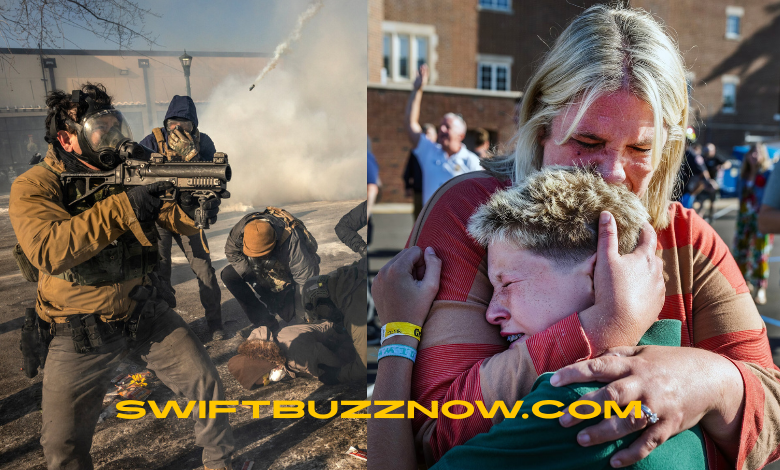
A quiet Minneapolis street has turned into the center of a national storm. What began as a routine federal enforcement operation has now escalated into one of the most debated law-enforcement incidents in recent U.S. memory. The phrase “minneapolis shooting today” is now trending across search engines, fueled by newly released surveillance footage, conflicting official statements, and growing public anger. Families, activists, and officials are all asking the same urgent question: what really happened in those critical seconds?
As the video spreads, emotions are intensifying. Supporters of accountability say the footage changes everything. Federal officials insist their officers acted under threat. Between these two narratives lies a widening trust gap that is reshaping public opinion and political debate. The minneapolis shooting today story is no longer just breaking news—it is becoming a national reckoning over transparency, policing standards, and federal authority.


What triggered the Minneapolis shooting today incident
The incident at the heart of the minneapolis shooting today reports stems from a federal enforcement operation conducted by immigration authorities in North Minneapolis. According to official statements, agents were pursuing individuals during a targeted operation when a confrontation escalated rapidly near a residential area. Federal agencies initially claimed officers were forced to respond after being threatened with objects and possible weapons during the encounter.
However, newly released city surveillance footage has complicated that narrative. The video reportedly shows a much shorter and less chaotic interaction than originally described by federal officials, with events unfolding in seconds rather than minutes. This discrepancy has become a major focus of journalists and legal analysts examining the minneapolis shooting today case, as it raises questions about proportional force and situational accuracy during high-pressure operations.
Surveillance footage and conflicting accounts reshape the narrative
One of the most significant developments in the minneapolis shooting today story is the release of surveillance video that appears to challenge earlier official claims. While federal authorities described a violent struggle, the footage shows a brief confrontation that many observers interpret differently. This has led to competing interpretations between government agencies, local officials, and independent analysts reviewing the case.
Civil rights advocates argue that the video suggests possible inconsistencies in official testimony, while federal representatives maintain that split-second decisions in dangerous situations cannot be fully understood without operational context. The minneapolis shooting today controversy has now expanded beyond the incident itself, becoming a broader debate about evidence transparency and public trust in law enforcement narratives.
Public reaction and protests intensify across Minneapolis
The minneapolis shooting today incident has triggered immediate and widespread reactions across the city. Demonstrations have taken place in multiple neighborhoods, with residents demanding full disclosure of all body camera footage and internal reports. Community leaders have called for restraint but also insist on accountability and independent investigations into federal enforcement actions.
At the same time, supporters of law enforcement argue that officers are operating in increasingly dangerous environments, especially during immigration-related operations. This divide has intensified tensions in Minneapolis, where previous enforcement actions have already sparked public protests. The minneapolis shooting today case has therefore become a flashpoint for broader national debates on immigration enforcement and policing practices.
Federal response and investigation developments
Federal agencies involved in the minneapolis shooting today incident have stated that internal reviews are underway. Some officers have reportedly been placed under administrative review as authorities examine whether protocols were followed correctly. Officials have also acknowledged that inconsistencies in initial reports are being investigated, although they emphasize that early statements often rely on incomplete information during active incidents.
Legal experts suggest that the outcome of this investigation could have significant consequences, not only for the officers involved but also for policy guidelines governing use-of-force standards. The minneapolis shooting today case may ultimately influence how federal agencies document and communicate critical incidents moving forward, particularly in urban environments with heightened public scrutiny.
Historical context: Minneapolis and repeated federal shooting cases
The minneapolis shooting today story is not occurring in isolation. Minneapolis has seen several high-profile federal enforcement shootings in recent months, creating a pattern that has drawn national attention. Previous incidents have already led to lawsuits, protests, and political pressure on federal agencies operating in the region.
Experts note that repeated confrontations between federal officers and local communities have eroded trust, especially when accounts of events differ between video evidence and official reports. This background is critical to understanding why the minneapolis shooting today incident has escalated so quickly into a national controversy rather than remaining a localized event.
Legal questions and accountability concerns emerge
As investigations continue, legal analysts are focusing on whether the use of force in the minneapolis shooting today incident met constitutional and departmental standards. Questions are being raised about escalation procedures, evidence handling, and the accuracy of initial incident reports filed by officers on the scene.
Civil rights groups are also calling for greater transparency, including the release of all body camera footage and internal communications. The minneapolis shooting today case may become a landmark moment in discussions about qualified immunity, federal oversight, and accountability mechanisms for immigration enforcement agencies operating in domestic settings.
What happens next in the Minneapolis shooting today case
The next phase of the minneapolis shooting today investigation will likely involve forensic analysis, witness testimony, and a detailed review of all available video evidence. Authorities are expected to release additional findings in the coming weeks, though officials caution that complex federal investigations often take months to fully conclude.
Meanwhile, public pressure continues to build. Advocacy groups are demanding independent oversight, while government officials are attempting to balance transparency with procedural integrity. The minneapolis shooting today story is far from over—it is evolving into a defining case that could shape future enforcement policies across the United States.
Conclusion: A case that could reshape trust in law enforcement
The minneapolis shooting today incident has moved beyond a breaking news headline into a deeper national debate about truth, accountability, and authority. With conflicting narratives, emerging video evidence, and rising public pressure, the case stands at a critical crossroads.
What happens next will not only determine the outcome for those directly involved but may also influence how future incidents are reported, investigated, and judged. As Minneapolis remains in the spotlight, one thing is clear: the demand for transparency has never been louder.
If you want updates on this developing minneapolis shooting today story, stay informed as new evidence and official statements continue to emerge.
